
e-ISSN: 2394-2967
logo

British Journal of Medical and Health Research

📢 Latest Update: Call for Papers: Special Issue on Medical and Health Research – Submit to British Journal (BJMHR) by March 31, 2026

📢 Latest Update: Call for Papers: Special Issue on Medical and Health Research – Submit to British Journal (BJMHR) by March 31, 2026

Volume 2, Issue 12 - 2015 (December 2015 Issue 12)

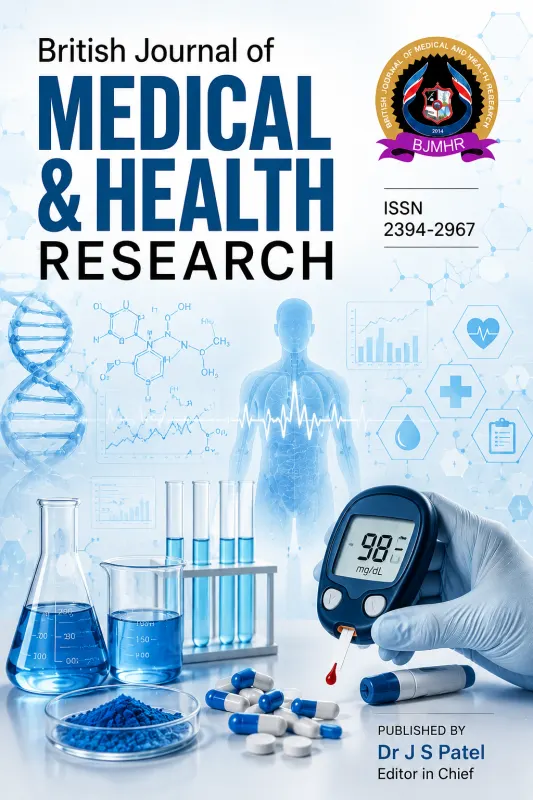
Volume 2 Issue 12 Cover

Issue Details:

Volume 2 Issue 12
Published:Invalid Date

Editorial: December 2015 Issue 12

Welcome to the 2015 issue of British Journal of Medical and Health Research. This issue showcases the remarkable breadth and depth of contemporary research across multiple disciplines. From cutting-edge applications of machine learning in climate science to the revolutionary potential of quantum computing in drug discovery, our featured articles demonstrate the power of interdisciplinary collaboration in addressing global challenges.

We are particularly excited to present research that bridges traditional academic boundaries, reflecting our journal's commitment to fostering innovation through cross-disciplinary dialogue. The integration of artificial intelligence with environmental science, the application of blockchain technology to supply chain management, and the convergence of urban planning with smart city technologies exemplify the transformative potential of collaborative research.

As we continue to navigate an era of rapid technological advancement and global challenges, the research presented in this issue offers both insights and solutions that will shape our future. We thank our authors, reviewers, and editorial board members for their continued dedication to advancing knowledge and promoting scientific excellence.

Dr Hemangi J Patel
Editor-in-Chief
British Journal of Medical and Health Research

Articles in This Issue

Showing 4 of 4 articles
Research PaperID: BJMHR0212001

Historical Overview of Nursing and Midwifery Education and Nursing Workforce in Rwanda

Harerimana Alexis, N G Mtshali, Donatilla Mukamana, Julie Kimonyo, Camille N. Kayihura, John Mugarura

Nursing education in Rwanda is undergoing rapid transformation. The literature reveals that the training of nurses and midwives in Rwanda started during the colonial era. Many of the nursing schools were opened by religious institutions such as Catholics, Protestants and Adventists, some being public and private. During 1980s there was a great transformation in nursing education in Rwanda, mainly by phasing out medical assistants, and education was restructured and the secondary program was fixed to 6 years; the nursing program was integrated in secondary education. In 1994, the Genocide against the Tutsi has seriously affected all sectors of life especially nursing. After the 1994 Genocide against the Tutsi, the Government of Rwandan invested in training nurses at various levels, and many public and private nursing and midwifery schools were opened. In 2007, a competency based approach was introduced in nursing education, and Public nursing schools were permitted to train nurses and midwives with advanced diploma (A1). Today, with the support from the Government of Rwanda, Nursing and Midwifery profession is becoming a pillar and cornerstone of Rwandan Health system.

History of nursing in AfricaNursing education in Rwandatransformation of education in RwandaNursing work force in Rwanda.
8,073 views
2,418 downloads

Contributors:

 Harerimana Alexis
,
 N G Mtshali
,
 Donatilla Mukamana
,
 Julie Kimonyo
,
 Camille N. Kayihura
,
 John Mugarura
Research PaperID: BJMHR0212002

Myasthenia Gravis And Rhabdomyolysis In A Patient With Advanced Renal Cell Cancer Treated With Nivolumab: A Case Report And Review Of The Literature

Danova Andrea Lopez, Alejandro R Calvo, Adam Fershko

Nivolumab is a fully human monoclonal antibody against programmed cell death 1 receptor (PD-1). Acting as an immune checkpoint inhibitor, it has emerged as a promising therapeutic method for advanced malignancy, inducing durable responses in patients with solid tumors. It can be associated to very unusual immune mediated toxicity against multiple tissues. Here, we describe a patient with metastatic clear cell renal cell carcinoma, who received nivolumab as fourth line therapy and experienced muscular weakness and pain secondary to rhabdomyolysis and myasthenia gravis. This case portrays a very uncommon yet potentially fatal side effect of nivolumab, seen in less than 1% of patients across all clinical trials. As immunotherapy evolves and its efficacy is proven in more tumor types, the overall use of this class of drugs will increase and their uncommon side effects may be evident more frequently. To our knowledge, this is the first case of fatal myasthenia gravis reported in a patient with renal cell carcinoma treated with anti-PD1 therapy.

Myasthenia GravisRhabdomyolysisrenal cell carcinomanivolumabAnti PD-1 blockade immunemediated side effects
7,987 views
2,397 downloads

Contributors:

 Danova Andrea Lopez
,
 Alejandro R Calvo
,
 Adam Fershko
Research PaperID: BJMHR0212003

HEMANGIOMA OF PARASPINAL MUSCLES MASQUERADING COLD ABSCESS A RARE CASE REPORT

Sohael M Khan, Mridul A Arora, Shounak Taywade, Shraddha K Singhania, Pradeep K Singh, Karan K Mane

Hemangiomas are abnormal proliferations of blood vessels, making up 7% of all benign soft tissue tumors. Their true incidence and prevalence are difficult to calculate, as the majority of lesions are small and asymptomatic. These lesions are largely congenital, but approximately 20% can be linked to trauma. They are very rare in paraspinal muscles. The prevalence of tuberculosis and cold abscess is quite high in our clinical setting. we are reporting a rare case report of hemangioma in paraspinal region mimicking as cold abscess. Intramuscular haemangiomas are very rare and paraspinal involvement being even rarer. Though tubercular abscess is common clinical problem, paraspinal Haemangioma should be considered as differential diagnosis.

HemangiomaCold abscessParaspinal Muscle
8,092 views
2,453 downloads

Contributors:

 Sohael M Khan
,
 Mridul A Arora
,
 Shounak Taywade
,
 Shraddha K Singhania
,
 Pradeep K Singh
,
 Karan K Mane
Research PaperID: BJMHR0212004

Postprandial Hypertriglyceridemia among Type-2 Diabetes Mellitus Patients of Chittagong, Bangladesh

Md Golam Abbas, Mizanur Rahman, Mahmudul Haque, Naila Al Mahmuda, Abul Kashem

Diabetes mellitus (DM) is a metabolic disorder of multiple aetiology characterized by chronic hyperglycemia with disturbances of carbohydrate,fat and protein metabolism resulting from defects in insulin secretion, insulin action,or both. The chronic hyperglycemia of diabetes is associated with long-term damage, dysfunction and failure of different organs, especially the eyes, kidneys, nerves, heart, and blood vessels. A case-control study was carried out in Chittagong Medical College, Chittagong, Bangladesh during the period of January 2012 to December 2012. The samples were collected from the department of Medicine, Chittagong Medical College Hospital. The age limits of the patients were from 30-70 years. The data were collected by a structured questionnaire including age, sex, blood pressure, total cholesterol. Total numbers of patients were 90 of which 50 were considered as cases (All type-II diabetic patients having (i) age 30-70 years (ii) Fasting blood sugar ≥ 7 mmol /L. (iii) Random blood sugar ≥11.1 mmol/L. (iv) 2 hrs. after oral glucose load is ≥ 11.1mmol/L and 40 controls (non-diabetic, age 30-70 years, absence of renal, liver and cardiovascular diseases). The study was designed to observe the postprandial triglyceride level in type-II diabetic patients. The mean fasting triglyceride level of cases was 210.70 (±19.5) and the 2hrs, 4hrs and 6hrs after test meals were 238.9 (±22.75), 260.5 (±15.36), and 260.32 (±5.94) respectively. At the same time the mean fasting triglyceride of the control was 173.75 (±19.86) and the corresponding mean of the control were 189.75 (±15.23), 174.38 (±16.49) and 173.88 (±15.79) mg/dl respectively. The fasting and postprandial (2hrs, 4hrs and 6hrs) triglyceride levels were significantly higher than that of corresponding control. There are also significant differences of triglyceride level in fasting and 2hrs, 4hrs and 6hrs after test meal among the cases which indicated that the triglyceride levels remained eleva

Type 2 diabetes mellitusTriglyceride (TG)Cholesterol
8,224 views
2,476 downloads

Contributors:

 Md Golam Abbas
,
 Mizanur Rahman
,
 Mahmudul Haque
,
 Naila Al Mahmuda
,
 Abul Kashem