
e-ISSN: 2394-2967
logo

British Journal of Medical and Health Research

📢 Latest Update: Call for Papers: Special Issue on Medical and Health Research – Submit to British Journal (BJMHR) by March 31, 2026

📢 Latest Update: Call for Papers: Special Issue on Medical and Health Research – Submit to British Journal (BJMHR) by March 31, 2026

Volume 11, Issue 10 - 2024 (October 2024 Issue 10)

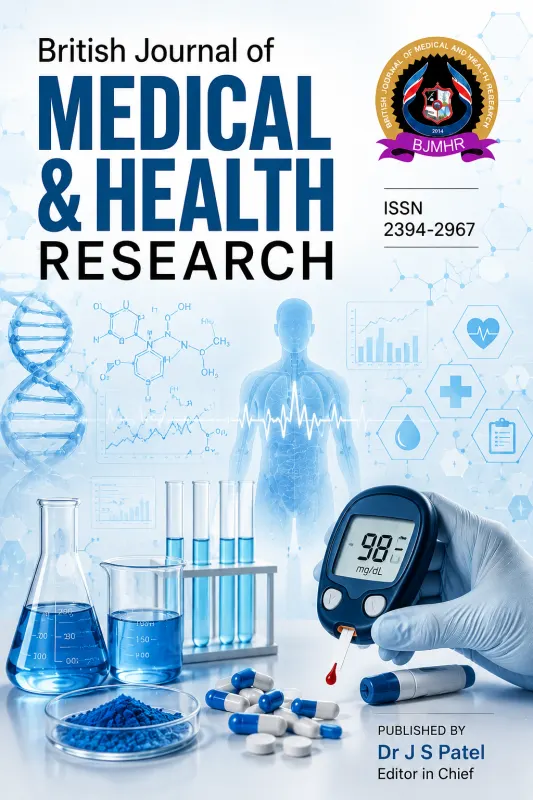
Volume 11 Issue 10 Cover

Issue Details:

Volume 11 Issue 10
Published:Invalid Date

Editorial: October 2024 Issue 10

Welcome to the 2024 issue of British Journal of Medical and Health Research. This issue showcases the remarkable breadth and depth of contemporary research across multiple disciplines. From cutting-edge applications of machine learning in climate science to the revolutionary potential of quantum computing in drug discovery, our featured articles demonstrate the power of interdisciplinary collaboration in addressing global challenges.

We are particularly excited to present research that bridges traditional academic boundaries, reflecting our journal's commitment to fostering innovation through cross-disciplinary dialogue. The integration of artificial intelligence with environmental science, the application of blockchain technology to supply chain management, and the convergence of urban planning with smart city technologies exemplify the transformative potential of collaborative research.

As we continue to navigate an era of rapid technological advancement and global challenges, the research presented in this issue offers both insights and solutions that will shape our future. We thank our authors, reviewers, and editorial board members for their continued dedication to advancing knowledge and promoting scientific excellence.

Dr Hemangi J Patel
Editor-in-Chief
British Journal of Medical and Health Research

Articles in This Issue

Showing 2 of 2 articles
Research PaperID: BJMHR1110001

NEWSPAPER COVERAGE OF MENTAL HEALTH ISSUES IN NIGERIA: 2016-2020

Donatus Uchenna Ajibo, Fidelis Ogbonnaya Asogwa, Ejike Patrick Egwu, Gabriel Ifeanyichukwu Ezeorah

One of the global health challenges today is the prevalence of mental illness. A mental disorder or mental illness (MI) is a syndrome characterized by clinically significant disturbances in an individual’s cognition, emotion regulation, or behaviour that reflects a dysfunction in the psychological, biological, or developmental processes underlying mental functioning. Newspapers, as part of the mass media, are saddled with the responsibility of covering mental ill-health. This study sought to explore the newspaper coverage of mental health issues in Nigeria. The content analysis technique was used to analyse four national newspapers: Daily Sun, The Guardian, The Nation, and Vanguard for five years. Code sheet was used as an instrument of data collection and agenda-setting theory and social responsibility theory were used to explain the study. Findings from the research revealed that the frequency coverage on mental illness is 321 with insanity as the most covered mental illness issue by the newspapers. The prominence given to the coverage of mental illness was low. More so, news was found to be the story genre that received the most attention. In terms of the direction of coverage, findings showed that the newspapers covered mental illness positively. The study also revealed that the selected newspapers did not give depth to stories on mental illness. Based on the findings, it is recommended among other things that Newspapers should endeavour to place essence in the interpretation and analysis of news reports on mental health issues.

Mental HealthMental IllnessNewspaperCoverageNigeria
61,232 views
18,424 downloads

Contributors:

 Donatus Uchenna Ajibo
,
 Fidelis Ogbonnaya Asogwa
,
 Ejike Patrick Egwu
,
 Gabriel Ifeanyichukwu Ezeorah
Research PaperID: BJMHR1110002

A Comprehensive Review on Management of Euglycemic Diabetic Ketoacidosis (EDKA) in Pregnancy

Somsubhra De, Keerthana Murali Tharan

Diabetic Ketoacidosis (DKA) is a life-threatening medical emergency. Euglycemic Diabetic Ketoacidosis (EDKA) is a condition that is relatively rare but if missed out can have grave consequences. The primary difference between the two conditions lies in the extent of hyperglycemia in both conditions. In EDKA, the blood glucose levels can be near normoglycemia as well. The clinical features are similar. Good glycemic control in pregnancy is an effective method of preventing complications of EDKA in pregnancy. For EDKA, the glucose levels in blood can be mildly raised, it poses a significant challenge to diagnose EDKA. Therefore, a high index of suspicion is the cornerstone of management of EDKA in pregnancy. The key diagnostic tests are serum electrolytes, arterial blood gas analysis, and ketone level measurements. The treatment includes fluid resuscitation, insulin therapy, acidosis correction, electrolyte monitoring and treating the underlying root cause. Continuous monitoring of both maternal and fetal well-being is crucial throughout treatment. A multidisciplinary and systematic approach to diagnosis and treatment is essential for an optimized outcome.

euglycemic DKAhyperglycemiadiabeticpregnancyketogenesisacidosis
61,351 views
18,273 downloads

Contributors:

 Somsubhra De
,
 Keerthana Murali Tharan